Introduction: The Workplace Melting Pot (and the Curious Clatter of Keyboards)
Step into any modern workplace today and you’ll find a curious cross-section of history and humanity. A Baby Boomer quietly jotting notes on a legal pad, a Gen X-er glancing at their calendar with weary realism, a Millennial half-tethered to Slack, and a Gen Z team member wordlessly contributing to the group chat with a perfectly timed meme. It’s part sitcom, part symphony — and entirely human.
Each generation brings its own rhythm and voice. Some prefer prose, others pictures. For some, “K.” is confirmation. For others, it’s an act of war.
Yet beneath the quirks and quiet clashes lies something rather beautiful: the potential for connection — if only we’re willing to listen and learn.
Part One: Speaking in Tongues – The Generational Languages of Communication
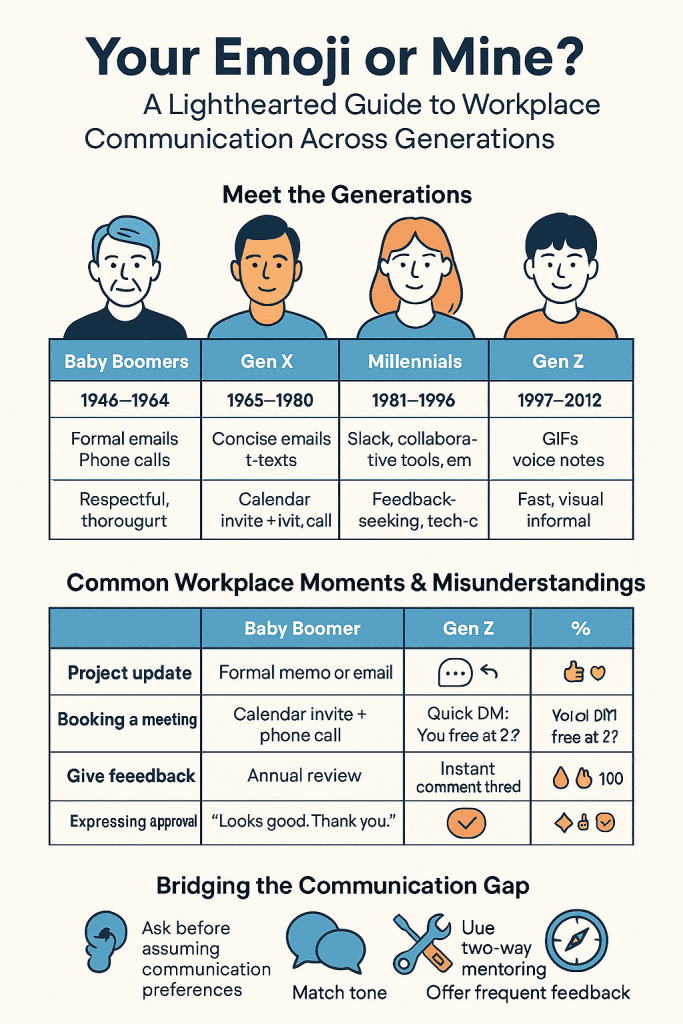
The Baby Boomers: Formal Dispatch and the Landline Legacy
Boomers are the seasoned explorers of the workplace map. They come armed with experience, integrity… and often, a fondness for a well-penned email, complete with salutations and courteous sign-offs. If you’re lucky, they’ll call you — with voice, not video — and expect you to answer.
There’s a gentle dignity to this formality. It speaks of an era when handwritten notes mattered and meetings weren’t just Zoom squares. If they send you an email, don’t be surprised if they follow up. With another email. Just to be sure.
Generation X: The Quiet Cartographers of Clarity
Pragmatic. Dry-witted. And perhaps the most under-celebrated of generations. Gen X are the bridge builders — fluent in analogue, fluent in digital — and often the ones quietly holding things together.
They survived floppy disks and dial-up tones, so they’re not fazed by new tech… just mildly inconvenienced by it. They appreciate brevity but loathe fluff. Their favourite emoji is probably a full stop.
Millennials: The Digital Diplomats in a Time of Transition
Millennials straddle two worlds. They remember cassette tapes, but also curated Spotify playlists. They send emails, but they also live in Slack threads and collaborative docs.
They’re masters of nuance. A “per my last email” is a velvet-gloved nudge, a reminder that yes, you were supposed to read that document two days ago. Their tone? Warm. Efficient. Slightly tired.
Generation Z: The Visual Virtuosos of the Modern Age
Then there’s Gen Z — native to the digital wilds, raised on screenlight and scrolls. They speak in memes, reaction gifs, and emojis with the precision of a Swiss watchmaker.
Watching them communicate is like observing a murmuration of starlings. Fluid. Fast. Coordinated. They might not say much, but their choice of GIF says it all. If Boomers are the letter-writers of the workplace, Gen Z are its performance artists.
Part Two: Crossing the Bridge – How We Find Our Common Ground
1. Become a Communication Chameleon (While Keeping Your Spots)
Great communicators adapt. Matching tone and medium to your audience isn’t losing your identity — it’s being considerate and effective.
A park ranger once demonstrated the power of switching seamlessly between different languages — from Afrikaans to English to bird calls — all to connect. Communication isn’t about the words, it’s about the connection.
2. Ask, Don’t Assume
“How do you like to keep in touch?” — such a small question, yet such a powerful one. Ask, and the awkwardness vanishes. You might even discover someone who prefers voice notes over emails. Or a spreadsheet wizard who thrives with a quick call.
Curiosity builds understanding. Whether in the boardroom or at the office kettle, people respond when you ask how they’d like to be understood.
3. Use Technology With Intention, Not Indulgence
Every generation has a favourite tool. What matters is choosing the right one for the job. Use video for warmth, chat for speed, email for permanence.
Technology is like good travel gear. Just because you’ve packed the drone and solar charger doesn’t mean you’ll use them all at once. Sometimes, a notebook and pencil do just fine.
4. Give Feedback Like You’d Offer a Compass
Millennials and Gen Z, in particular, thrive on feedback; it’s how they map their growth. But everyone, regardless of age, benefits from feedback that is clear, regular, and supportive. The generational gap often appears in the delivery.
The old model of a single, formal, annual review is no longer enough. The new model is about “quick-touch” feedback that is immediate and actionable.
Technique 1: The “SBI” Model for Quick Feedback
Don’t be vague. To give clear, effective feedback, you must be specific. Use the Situation-Behaviour-Impact model.
- Situation: State when and where it happened. (e.g., “In the team meeting this morning…”)
- Behaviour: Describe the specific, observable action. (e.g., “…when you presented the sales data…”)
- Impact: Explain the result of that action. (e.g., “…the way you linked it to our Q3 goal was brilliant. It got the whole team on board.”)
This model works for both positive and constructive feedback:
- Vague (Bad): “Good job in the meeting.”
- SBI (Great): “(Situation) In this morning’s client call, (Behaviour) when you used that analogy about the ‘two-lane highway,’ (Impact) I saw the client’s face light up. You completely clarified the issue for them. Brilliant work.”
Technique 2: Adapt Your Channel and Framing
Whilst the content of your feedback should be consistent (using models like SBI), the channel and framing can adapt.
- Giving Feedback to a Boomer or Gen X-er: They may prefer a more private or formal setting.
- How: A scheduled one-to-one, a direct phone call, or a structured email. They often value experience, so you can frame it as: “I’ve seen this situation before, and one thing that really helps is…”
- Giving Feedback to a Millennial or Gen Z-er: They are often accustomed to immediate, real-time feedback, even in public channels.
- How: A quick, direct message on Slack or Teams right after a meeting (e.g., “Brilliant job on that client call!”). They also respond well to a collaborative, coaching-based approach: “That was a good start. What do you think went well, and what would you change next time?”
Acknowledging effort—not just the final outcome—builds a foundation of trust that bridges any generational divide.
5. Mentoring, But Make It Mutual
The best mentoring is reciprocal. Let the experienced guide the curious. And let the digital-savvy teach the traditional. Everyone learns. Everyone grows.
The problem is that this rarely happens on its own. True mutual learning needs to be intentional. It’s not just about watching a seasoned team leader fumble through TikTok whilst their twenty-something colleague cheers them on; it’s about formally creating a structure where both parties are teachers.
Technique 1: Formalise “Reverse Mentoring”
Don’t just hope for it; schedule it. A reverse mentoring programme is a powerful, practical way to bridge the skills gap.
- How to do it: Pair a senior leader with a junior-level or new-starter colleague. The brief is simple: for 30 minutes, once a month, the junior colleague’s “job” is to teach the senior leader about a specific topic they’ve flagged. The senior’s “job” is only to listen and ask questions.
- Example:
- Senior Partner’s Goal: “I don’t understand why our new product isn’t landing with Gen Z. I feel out of touch with their buying habits.”
- The Action: You pair them with Ben from the grad scheme. Ben’s task isn’t to “teach TikTok,” but to explain how he and his friends discover new products and what they look for in a brand. This gives your senior leader direct, invaluable market insight, and it gives Ben high-level exposure and confidence.
Technique 2: The “Barter-Based” Skill Swap
This is the informal, day-to-day version. It’s a simple, respectful trade of skills. As a leader, you can initiate this to show that your skills are not the only ones that matter.
- How to do it: Identify a skill a team member has that you lack, and offer a trade for one of your own.
- Example Script (from a manager):
- “Dave, your grasp of Excel pivot tables is frankly brilliant, and it takes me ages. I’d love for you to show me your 10-minute method. In return, I’d be happy to walk you through the presentation framework I use for pitching to clients.”
- “Sarah, your emails are always so punchy and clear. I tend to waffle. Could you show me your process? In return, I can introduce you to our contact at [Partner Company].”
This technique flattens the hierarchy and shows that everyone has valuable expertise, transforming the workplace into a genuine hub of mutual learning.
Final Thoughts: A Symphony, Not a Solo
At heart, communication isn’t about being identical. It’s about being intentional. Like any good expedition team, a workplace thrives not when everyone speaks the same, but when everyone is heard.
So the next time your email gets a “👍” or someone asks if Slack is “that new lunch place,” smile gently. You’re not in the wrong camp — you’re just on the same journey, walking different paths toward the same summit.
Let’s listen. Let’s learn. And let’s laugh along the way.